About the EUCBAM Carbon Reporting
With the EU Carbon Border Adjustment Mechanism (CBAM) set to enter its charging phase in 2026, some imported goods, particularly those from industries with high carbon emissions such as steel and aluminum, may need to bear the corresponding carbon emission costs when entering the EU market in the future.
To ensure the smooth customs clearance of customer goods in the EU, the following is an explanation of the relevant policies and operational procedures for CBAM:
Part1What isCBAM?
The EU Carbon Border Adjustment Mechanism (Carbon Border Adjustment Mechanism) commonly known as the "carbon tariff", is not a traditional tariff but a regulatory mechanism based on the carbon content of goods. CBAM is a mechanism that imposes an additional fee or requires the purchase of corresponding emission permits for specific goods imported into the EU market, based on the amount of carbon emissions produced during their production. The core purpose is to make importers bear similar carbon costs as EU domestically produced products, prevent "carbon leakage", create a level playing field, and promote the green transformation of global industries. The key process is that products exported to the EU need to declare the "embedded carbon emissions" of the production process.
From January 1, 2026, CBAM officially enters the charging phase, but it will only be gradually implemented at 2.5% of the emission volume in the early stage, and it will gradually transition to 100% before 2034.
Part2Who is affectedby CBAM?
1 Applicable Entity
Importers: within the European Union territory, importers of goods covered by the CBAM will need to declare carbon emissions and comply with related obligations.
The responsibility of our company: assist customers in completingCBAM compliance work, including data collection, preparation of results, and assistance in declaration after authorization.
2 Applicable Products
CBAM currently covers the following categories of goods (classified according to HS codes):
SteelAluminumCementFertilizerHydrogenElectricity
❗️From the current policy, CBAM mainly targets industrial products with high carbon emissions, such as steel, aluminum, cement, etc. For most products commonly seen by cross-border e-commerce sellers, such as furniture, lighting, household goods, textiles, consumer electronics, etc., they are usually not covered by the CBAM supervision.
specificHS code list can be referred to the official documents of the European Union (see details in China on P482-P535),
Click to download:CBAM HS Code List (China Part P482-P535)https://www.kdocs.cn/l/cqZZFrp8YS0Y
3 threshold
CBAM obligations are based on the gross weight of imports (tonnes), with the annual cumulative total of imported tones being the determining factor. The EU has set simplified thresholds for some small-scale imports (usually within 50 tones per year), within which simplified declarations or免於缴费 arrangements may apply, but the specific determination still needs to be made according to the commodity category and the importer.
4 key time nodes
SinceJanuary 1, 2026: Imported CBAM products require authorization from an authorized CBAM declarer (importer or indirect representative).
Part3
What documents are needed before customs clearance?
⚠️Important note:Importers involved in CBAM must provide the following complete data, otherwise it will affect their import qualification in the EU, resulting in the goods not being able to clear customs smoothly.
If the goods you import involveCBAM-related HS codes, please cooperate to fill in the Excel spreadsheet, including the following information:
CBAM Importer Information Filling Template Download Link:https://www.kdocs.cn/l/csBJIxjO9dB
1 Basic information of the importer
Company name, full address,EORI number, contact (name/email/phone)
2 Annual Import Data
Import forecasts for the whole of 2026 and 2027 broken down by HS code, each line including: product description, net weight (tonnes), value and country of origin.
Part4How to calculate the carbon emission fee?
CBAM is different from traditional tariffs, which are based on the amount of carbon dioxide emissions in the production process of goods.
The sameThe customs code declared by the same VAT importer for the products is one of the classifications of CBAM products (ref. China part P482-P535, the first four digits of the HS CODE)
CBAM cost calculation formula: Imported declared quantity (net weight/ton) * Emission coefficient * EU government-set emission share (2.5% for 2026) * ETS fee value
1 Import declaration quantity (net weight in tons of each declared product):
Such as:7326909890 declared net weight of 63.61 tons; 7616999099 declared net weight of 1.48 tons.
2 Emission factors:
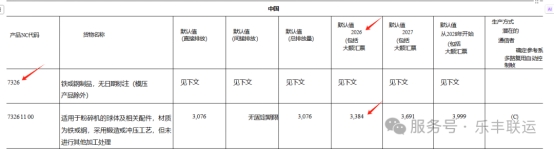
According toHS classification default value, it can be referred to -- China part P482-P535, the first four digits of the HS CODE.
3 Allocation of emission allowances:
The EU government has set the emission shares as follows, wherethe proportion applicable in 2026 is 2.5%.

4ETS Fee:
Refer to the EU directive on the allocation of *** greenhouse gas emissions, the price fluctuates daily, and the value on the day of payment is subject to the official EU website announcement.
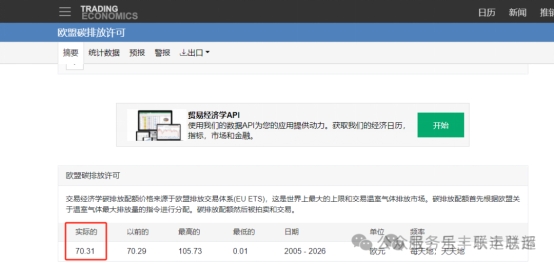
Reference link:https://tradingeconomics.com/commodity/carbon
5Example calculation:
CBAM cost calculation formula: Imported declared quantity (net weight/ton) * Emission coefficient * EU government-set emission share (2.5% for 2026) * ETS fee value

GoodsA's CO₂emissions=63.61×3.384=215.26 tons
GoodsB's CO₂Emission=1.48×6.115= 9.05 tons
Two goods cumulative emission=(215.26 + 9.05) × 2.5% =5.61=6 tons CO₂(Round up the value)
Carbon emissions expected to be generated=6 tons x 70.31 euros (ETS cost) ≈421.86 euros
Part5
Payment methods for fees
Extracted from the customs declaration system, the information and cumulative data of VAT importers involved inCBAM products, the following operations are performed:
If involvedIf the annual cumulative import weight of CBAM products exceeds 50 tons, and the customer needs our company to assist in declaration, our company will charge according to the actual assistance paid for carbon emission fees, and an additional fee for declaration services will be charged.
Customers can choose the following payment methods according to their own situation
Method One: Our company assists in compliance declaration.
Assist in paying based on actual carbon emissions and provide payment certificates. If you need our company's assistance in declaration, you need to sign the following documents:
①authorization letter containing the CBAM clause
② Sign the contract
2 Method Two: Customer Self-Payment
After the customer pays the fees, they need to provide the company with the receipt of tax payment to complete the customs clearance process.
If you have any questions aboutCBAM declaration, please feel free to contact our customer service group or logistics manager, we will provide you with professional guidance and support.